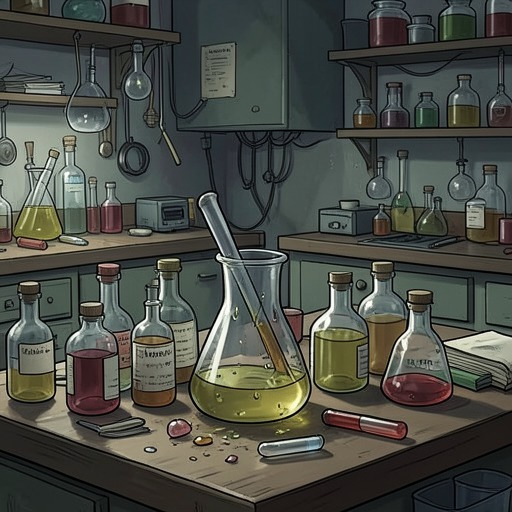
Chemical synergism
Silent SpringChemical synergism is the amplification of a chemical’s toxicity through its interaction with another substance, sometimes turning exposures that appear limited when considered separately into a far more dangerous combined dose. In the book, this is not a remote laboratory possibility: pesticide mixtures can reach workers and consumers, residues within legal limits can interact, and a non-insecticide can intensify an insecticide’s effects. The concept exposes a basic weakness in judging chemical safety one substance at a time.
How combined exposure magnifies toxicity
A team of Food and Drug Administration scientists found that simultaneous administration of malathion and certain other organic phosphates could produce poisoning as much as fifty times more severe than would be predicted by adding the two compounds’ toxicities. The finding was not simply that two poisons could each do harm. Their combined action could sharply magnify the harm beyond the expectation formed from either chemical alone.
Follow-up testing showed that many pairs of organic phosphate insecticides were highly dangerous in combination. The book calls this increase in toxicity potentiation: one compound can destroy the liver enzyme responsible for detoxifying the other. The interaction therefore alters the body’s ability to handle a poison, rather than merely adding another independent toxic effect.
Exposure need not be simultaneous
The danger does not depend on taking both substances at once. A person might spray one insecticide one week and another the next, yet the sequence can still create a hazard. This matters because exposure is spread across work and time, while a substance’s effect on the body may change how a later chemical is processed.
Consumers can also encounter mixtures without knowingly handling pesticides. Sprayed products may carry residues of different organic phosphates into the same meal; the book uses the everyday image of a salad bowl to make this route concrete. Residues can each remain within their legally permissible limits and still interact. A limit applied to each chemical in isolation therefore cannot, by itself, establish that the combined exposure is harmless.
Chemicals beyond pesticides can intensify the effect
The interactions described are not confined to pairs of insecticides. The book reports that an organic phosphate’s toxicity can be increased by a second agent that is not itself an insecticide. One example is a plasticizing agent that may make malathion more dangerous by inhibiting the liver enzyme that would ordinarily detoxify it.
This mechanism gives the concept a wider reach than a warning about pesticide mixtures. Chemicals encountered for different purposes may converge in the body, and their combined effects may depend on what one does to the body’s capacity to neutralize another. The full scope of these interactions was described as little known, even as disturbing findings continued to emerge from laboratories. The uncertainty is part of the problem: the set of relevant combinations cannot be assumed to stop at chemicals already classified as pesticides.
A wider problem of mixed exposure
The book places synergism within a general account of human exposure. People do not live under the rigidly controlled conditions of laboratory animals and are not exposed to only one chemical. Interactions among major insecticide groups, and between insecticides and other chemicals, therefore complicate any assessment of pesticide poisoning. Even a single exposure can precipitate acute poisoning when the amount is large enough, but the book distinguishes such incidents from the broader problem created by mixed exposures.
A related, though distinct, concern is the cumulative storage of chemicals. DDT is fat-soluble and is stored in fatty tissues and organs; its storage begins with very small intake and continues as exposure accumulates, while the body excretes these small amounts slowly. This describes persistence and accumulation rather than the specific enzyme-mediated potentiation of malathion, but it reinforces the book’s larger point: dose cannot always be understood as a single, isolated encounter. Both accumulation over time and interactions among substances make exposure histories consequential.
Significance
Chemical synergism changes the unit of analysis from the individual chemical to the mixture, its timing, and its effects on the body’s defenses. A test or legal limit for one substance may miss a danger that appears only when another chemical is present, whether the second arrives in the next week’s work, in food residues, or through an unrelated use such as plasticizing. The concept thus unsettles the reassuring appearance of separate permissible amounts: chemicals do not necessarily remain separate in their effects once they meet in the body.